
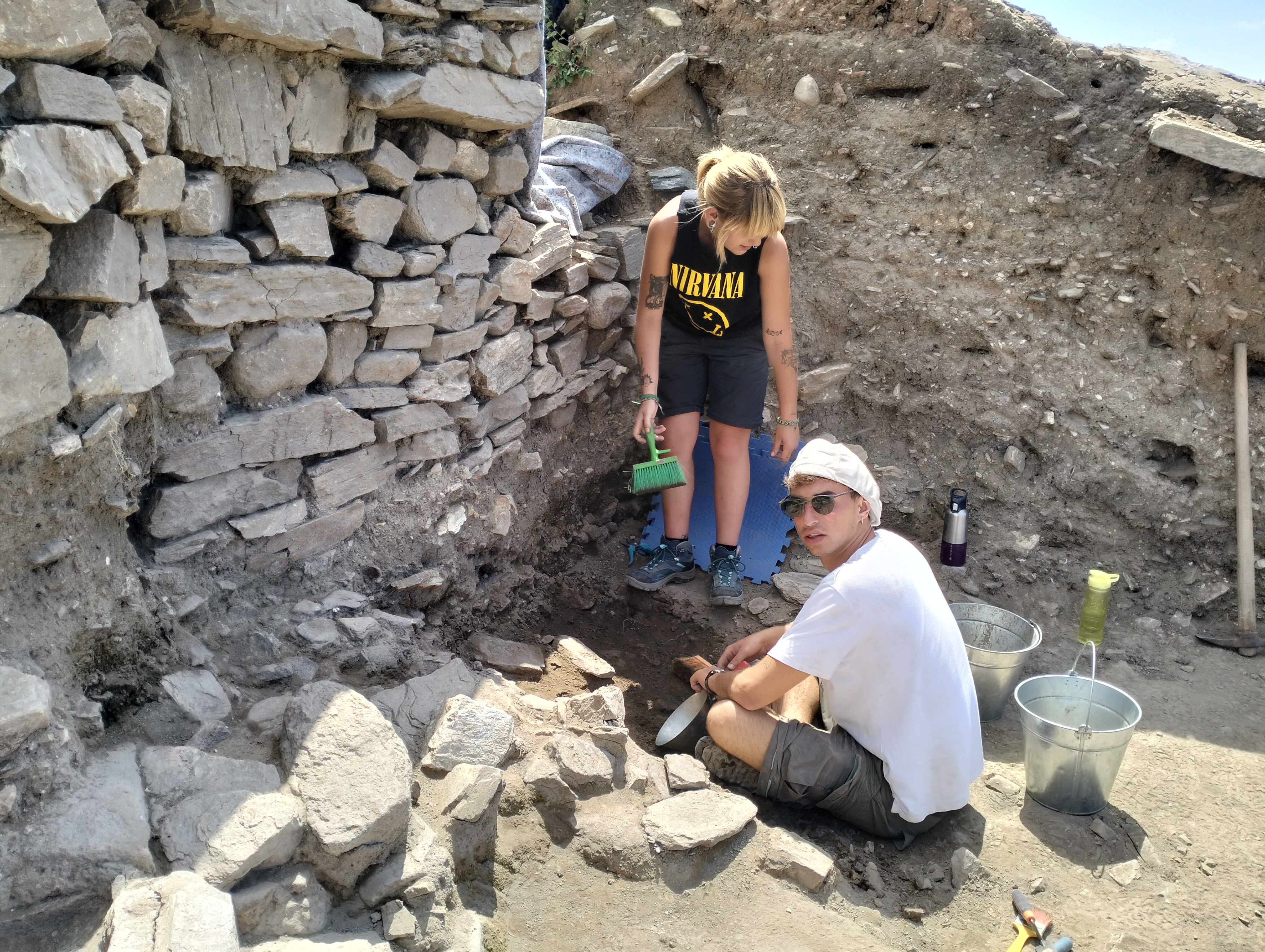
The topic of my story now is a heritage that we’ve received from previous group of volunteers spent June-July 2025 in the same place Rupite village (Bulgaria) and help to the same team of archaeologists leading by Prof. Luidmil Vagalinski. Due to some circumstances, our project was moved from Turgovishte town (where we initially suppose to help to Ancient town Heraclea Sintica in Bulgaria). Due to the short time and all our preparation for Turgovishte, now we were faced with a lot of questions in our minds: what to expect here? How the life and project activities could be organized in a good and memorable way.
To answer of all our doubts and questions we make a virtual connection with Pedro Inesta, that was a leader of the group of volunteers spent 45 days in the same place with the same local people around. Conversation with him was very informative and useful. And how all of us come her to search in the past, we start with exploring the experience and artefacts of volunteers before us. So, see what we learn from Pedro:
Pedro Iniesta knew very little Bulgarian and very little English when he left his village of Tres Cantos, which is close to Madrid. Nevertheless, he was unable to avoid the adventure that Bulgaria had in store for him: “Working at archaeological sites, meeting new people, practising languages, and learning to live with myself,” he recalled. What started off as a straightforward archaeological study turned into an adventure that changed his life and put his patience, sensitivity, and leadership skills to the test.
In his capacity as coordinator, Pedro oversaw a smaller group in the village of Garmen and led a group of eleven foreign volunteers on an urgent excavation. The pressure was intense because it was his first significant leadership experience. “A leader’s main tool is setting an example - showing humility, commitment, good spirits, and the ability to admit mistakes,” he said. He had to combine the needs of the archaeologists with the well-being of the team every day. Pedro found harmony by communicating and demonstrating empathy, despite the inevitable arguments and fatigue. He organised meals and barbecues that turned several strangers into friends. “Friendship cannot be forced,” he reflected, “but creating opportunities for connection helps it flourish.”
The group was based in Rupite, which is close to Bulgaria's borders with North Macedonia and Greece. They frequently visited Sofia, Plovdiv, and the Seven Rila Lakes. In addition to boosting Pedro's spirits, these excursions taught him early on that he couldn't control everything. “My first mistake as coordinator was taking on too much responsibility,” he admitted. “I learned that leadership means facilitating rather than controlling.”
At the excavation site, Pedro rotated tasks so that everyone could learn and feel valued. He vividly remembers one volunteer, Daniel, who became deeply attached to a tomb he had been excavating. “He even thought about it on weekends,” Pedro said. “That sense of ownership is what makes a team thrive - when everyone feels their contribution truly matters.”
Beyond the job, rural Bulgarian life taught a new kind of lesson: how to connect without using words. The volunteers developed a close relationship with the residents, particularly with an elderly neighbour they referred to as Baba, who frequently provided them with veggies from her garden. “We could only respond with ‘blagodaria’ for each tomato she brought us,” Pedro laughed. “Once she even pretended a courgette was a gun, laughing as we played along.”
Those simple moments - playing football with local children, chatting through gestures, and sharing food - helped the group feel at home. “That daily coexistence helped us not only to integrate,” Pedro said, “but also to make that little corner of Bulgaria our own.”
The experience was not without challenges. “As a leader, it was exhausting, demanding, and at times painful,” he admitted. But through it, he discovered patience, emotional intelligence, and the importance of trust. “True strength comes from letting the team take responsibility and believing in its ability to self-manage.”
His advice to future leaders is simple: “Take care of yourself. Leadership can be exhausting, so resting and reflecting each day is essential. Caring for yourself is also a way of caring for the group.”
What left the deepest impression on Pedro, however, was Bulgaria itself - its rich history, natural beauty, and the kindness of its people. He fondly remembers Kolo, who shared his passion for archaeology; Plami, who became a close friend; and Pepa, who trusted him with responsibilities. “These encounters showed me that Bulgaria is not just a place to visit,” he said, “but a place to experience and make your own.”
Pedro brought much more than memories back to Spain. “I return with priceless experiences, a new perspective on Bulgaria, my own country, and myself,” he reflected. “Bulgaria gave me confidence, a sense of the world’s vastness, and a place I will always want to return to.” To anyone considering a similar adventure, his message is simple: “You won’t regret it - you’ll be grateful.”